A Wrapper class is a class whose object wraps or contains a primitive data types. When we create an object to a wrapper class, it contains a field and in this field, we can store a primitive data types. In other words, we can wrap a primitive value into a wrapper class object.
To get in-Depth knowledge on Java you can enroll for a live demo on Java Online Training
Need of Wrapper Classes
- They convert primitive data types into objects. Objects are needed if we wish to modify the arguments passed into a method (because primitive types are passed by value).
- The classes in java.util package handles only objects and hence wrapper classes help in this case also.
- Data structures in the Collection framework, such as ArrayList and Vector, store only objects (reference types) and not primitive types.
- An object is needed to support synchronization in multithreading.
Primitive Data types and their Corresponding Wrapper class
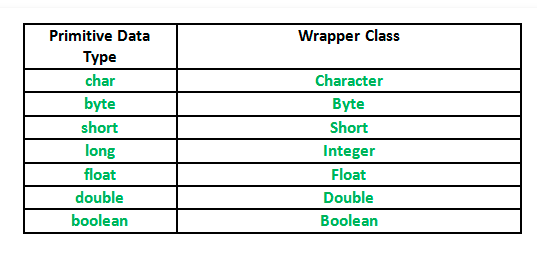
Autoboxing and Unboxing
Autoboxing: Automatic conversion of primitive types to the object of their corresponding wrapper classes is known as autoboxing. For example — conversion of int to Integer, long to Long, double to Double, etc.
Take your career to new heights of success with Java Training
Example:
// Java program to demonstrate Autoboxing
import java.util.ArrayList;
class Autoboxing
{
 public static void main(String[] args)
 {
  char ch = 'a';
// Autoboxing- primitive to Character object conversion
  Character a = ch;
ArrayList<Integer> arrayList = new ArrayList<Integer>();
// Autoboxing because ArrayList stores only objects
  arrayList.add(25);
// printing the values from object
  System.out.println(arrayList.get(0));
 }
}
Output:
25Unboxing: It is just the reverse process of autoboxing. Automatically converting an object of a wrapper class to its corresponding primitive type is known as unboxing. For example — conversion of Integer to int, Long to long, Double to double etc.
// Java program to demonstrate Unboxing
import java.util.ArrayList;
class Unboxing
{
 public static void main(String[] args)
 {
  Character ch = 'a';
// unboxing - Character object to primitive conversion
  char a = ch;
ArrayList<Integer> arrayList = new ArrayList<Integer>();
  arrayList.add(24);
// unboxing because get method returns an Integer object
  int num = arrayList.get(0);
// printing the values from primitive data types
  System.out.println(num);
 }
}
Output:
24Implementation
// Java program to demonstrate Wrapping and UnWrapping
// in Java Classes
class WrappingUnwrapping
{
 public static void main(String args[])
 {
  // byte data type
  byte a = 1;
// wrapping around Byte object
  Byte byteobj = new Byte(a);
// int data type
  int b = 10;
//wrapping around Integer object
  Integer intobj = new Integer(b);
// float data type
  float c = 18.6f;
// wrapping around Float object
  Float floatobj = new Float(c);
// double data type
  double d = 250.5;
// Wrapping around Double object
  Double doubleobj = new Double(d);
// char data type
  char e='a';
// wrapping around Character object
  Character charobj=e;
// printing the values from objects
  System.out.println("Values of Wrapper objects (printing as objects)");
  System.out.println("Byte object byteobj: " + byteobj);
  System.out.println("Integer object intobj: " + intobj);
  System.out.println("Float object floatobj: " + floatobj);
  System.out.println("Double object doubleobj: " + doubleobj);
  System.out.println("Character object charobj: " + charobj);
// objects to data types (retrieving data types from objects)
  // unwrapping objects to primitive data types
  byte bv = byteobj;
  int iv = intobj;
  float fv = floatobj;
  double dv = doubleobj;
  char cv = charobj;
// printing the values from data types
  System.out.println("Unwrapped values (printing as data types)");
  System.out.println("byte value, bv: " + bv);
  System.out.println("int value, iv: " + iv);
  System.out.println("float value, fv: " + fv);
  System.out.println("double value, dv: " + dv);
  System.out.println("char value, cv: " + cv);
 }
}
Output:
Values of Wrapper objects (printing as objects)
Byte object byteobj:  1
Integer object intobj:  10
Float object floatobj:  18.6
Double object doubleobj:  250.5
Character object charobj: a
Unwrapped values (printing as data types)
byte value, bv: 1
int value, iv: 10
float value, fv: 18.6
double value, dv: 250.5
char value, cv: a
To learn more about Wrapper Classes in Java and other great features of Java, you can enroll for a live demo on Core Java Online Training
 Biztalk Online Training