Future Scope of Robotic Process Automation

The technology is advancing rapidly in almost all the fields, not in a minute but in every second. With this quick development in technology, tremendous growth has been observed in the global automation industry. The usage of automation techniques is in continuous growth and it is anticipated for the predictable future. The robotic process automation is one of the revolutions in the automation industry, and it is expected to increase higher potential in terms of utilization and staff implementation in the upcoming year.

Robotic Process Automation, particularly focuses on the process automation of those industries which are mostly business oriented and are handled by humans. Using RPA, all the operations would be automated easily, but it is expected that it will replace the human jobs because in the future the robotics oriented automated tools will be highly effective.

The robotic process automation is basically a software in which a robot is involved and used to perform human activities. These robots are used to carry out the organizational tasks and they are organized in such a way that they can manage any data or actions for the current applications which are used to carry out several business processes. The robots which are involved in RPA has to be trained and once they are trained, they can be automatically used to carry out the preferred functions.

To get in-Depth knowledge on Pega RPAyou can enroll for a live demo on Pega robotic process automation training

The operations which are automated involves a wide range of manipulation of data, activating responses and improving communications within several systems. The main objective of RPA is to decrease the need for the extra workforce, to carry out the large volume of IT jobs which are related to support the remote infrastructure, workflow, and other back-office processes related to the financial field, accounting, human resources, customer services and supply chain management. With RPA, it is possible to perform the work seamlessly, as it saves a lot of time and also helps to reduce the chances of human errors.The RPA software utilizes multi level features for data collection, configures the digital data and connecting it to a server or a website.

Well, the future scope of RPA is relatively very high. There are various human jobs which can be easily automated using RPA tools and technology. The future scope of RPA can be observed in the field of data entry and data rekeying jobs. These tasks could be easily automated with RPA. The various repetitive tasks such as formatting, data assembling or anything which requires a series of steps are easily carried out with the help of RPA.

The other computer-supported processes which utilize a set of procedures are also performed through RPA. The RPA would be helpful in improving the data collection and these data can be analyzed in a better way, if all the tasks which are carried out by humans today are performed by robots. During the upcoming year, a tremendous growth is observed in the field of RPA and therefore it will deliver higher technological abilities towards significantly reducing the risk of incorrectly regulatory reporting, including the improved data analytics and higher data accuracy. The RPA in the market is progressing rapidly and acceptance of this robotic automated technique could help to restructure the business process management marketplace. This is due to the following benefits of Pega RPA:

1. Efficiency: The software robots are highly efficient they can operate 24/7 without taking any break.

2. Accuracy: In order to carry out data entry task, the robots can perform it in the same way as the human beings without making any mistakes.

3. Cost Reduction: The software robots help to reduce the organizations cost.

4. Change management can be performed easily by the RPA as it reserves the application and data integrity.

5. Enhanced audit and monitoring compliance: A detail audit logs are offered by the robots by allowing the advanced business analytics and enhanced compliance.

Take your career to new heights of success with the Pega robotic process automation course

The RPA’s influence will go to range within the organizations. Nowadays, most of the organizations are executing RPA to automate their various business processes, its impact will become higher in the future. The RPA will be utilized in different ways and through maximum processes as compared to the present utilization within an organization.

RPA will not only focuses on its internal processes, in addition to this, it will also going to emphasis on external as well as customer-oriented processes from now. The incoming email sorting is one of the examples in which the huge productivity can be delivered by the smart robots.

This analysis shows that the influence of RPA within the organization would be greater in the forthcoming years than the previous years in terms of overall business. An amount of this will occur when implementation of RPA begins to change from the initial and proof of concept to real production. The RPA is tested in most of the organizations and its usefulness is proved in every situation and thus it can be taken at the succeeding level by most of the businesses. Further innovation can be seen in the RPA area at this stage and new applications would also arise positively.

It has been observed that if any of the automation tools are integrated with other tools it will function flawlessly. The RPA will be utilized with other types of technologies as well because most of the companies realized that the automated tools do not function properly alone but they will give their best results when combined with the other tools.

It does not mean that the RPA would not provide appropriate results alone. Definitely, you will get the proper outcomes, the next step is not just to grow the RPA technology alone, but it can be expanded into other tools which the organization is using. The RPA is more versatile, commanding and big tool, which alone can solve several functions, but the finest consequences would be gained by utilizing the RPA with the other tools.

RPA performs the tasks very well on its own, but in the future, those who are practicing the RPA, expects that it will create a more powerful total workforce when it is incorporated with the tasks carried out by human employees. The RPA will be used together with the process and work management tools, that is the tools like Kofax Total Agility, in which the features like case management is involved.

Well, the subsequent step in the Robotic Process Automation is the self-learning competencies and Artificial Intelligence. The RPA will develop itself as RPA 2.0. The AI would not be similar to this innovative technology. It will move further than a rule-based technology and begin to combine the various features of artificial intelligence. The discussion will move away from the RPA towards the Smart process automation in the upcoming year. This transition will lead to inventions that make the business processes more smarter than today. In order to make the changes completely, the digital transformation platforms can be utilized.

Career Scope of RPA:

The scope of RPA is infinite and huge. In fact, it is anticipated that the RPA will be the future of IT automation. If someone wants to build his or her career in RPA this particular field will automatically grow their career views. The field of Artificial Intelligence is one of the prospects and it would include the innovative level of decision making and job implications. Also, the RPA would show its great prospects in the banking domain, where the robots will going to be utilized to practically perform all the calculations and transactions. It will also show its consequences in more leading-edge technology in the area such as automobiles and aircraft manufacturing.

It is highly anticipated that regular as well as online courses are going to barb up extremely in the next approaching years. Most of the RPA tools such as RPA Blue Prism, UiPath, automation anywhere are already being used in the business. The candidate who wants to build their career in the field of RPA can learn any of this tool to implement the RPA in the future.

Conclusion:

The RPA will be going to used in various industries and domains. It will not only be utilized in industries such as banking and insurance but will also show its impact on industries like manufacturing, aviation, oil and gas, retail and analytics. It is expected that RPA market is going to reach about USD 8.75 billion by the year 2024.

It has been observed that the RPA is evolving as a troublesome technology, which has the capacity to provide the several benefits such as improved accuracy, cost reduction, scalability, and compliance. The RPA tools are less costly than the full-time staff, it is expected that the RPA will disrupt the predictable business process model and change the global subcontracting industry. The RPA technology is not very expensive or complex and a huge career growth is expected in the upcoming years. The market of automation would increase in the future and it will be the key for a large job creation.
Pega CPBA and overview of process management

A PEGA CPBA is an individual who has passed the PEGA Business Architect test. A business architect is a person who integrates a company’s schemes and resources. Thus, is to achieve its predetermined objectives and goals.

The business architect uses business architecture to create and sustain business prospects. This is a corporate strategy management organization. Moreover, you also contribute to the strategy and plans for the market.

To get in-Depth knowledge on Pega cpba you can enroll for a live demo Pega ba certification

Certification of PEGA Company Architect (PCBA)

PCBA certification focuses on the ability in PEGA application design and development. In the PEGA application, PCBAs possess basic, critical skills. Moreover, these skills are necessary to evaluate, design. Thus, it builds business requirements and specifications.

This PCBA certification is for business architects. Thus, this certification helps in learning how to build PEGA Platform applications.

You will learn the basic concepts of application creation on the PEGA Platform. This is with this PEGA PCBA certification. Moreover, these concepts are in use by business users and control team members. This is to prepare and execute business applications faster. Thus, it is more accurate for optimal business benefit.

A corporate architect:

  • Design templates for capabilities.
  • Plan architectural solutions for company assignments.
  • Develops plans to transform the company together with senior business management.
  • He manages the company’s operational business activities.
  • Develops architectural governance and controls over execution and retains them.
  • Take your career to new heights of success with Pega business analyst training

How do you become a PEGA CPBA Company Architect Accredited by PEGA?

  • The PEGA CPBA exam
  • Pega Business Architect Version 8 certification.

Moreover, this focuses on taking part, including business goals. Thus, needs, in the design and development of a Pega application.

The PEGA CPBA Exam Overview:

The PEGA CPBA exam is administered by Pearson Vue. Thus, to pass the PEGA CPBA test, an applicant must receive 70 percent marks. The 90-minute test consists of 50 questions.

Scenario-based questions, multiple-choice questions, and drag/drop items. These are in the PEGA CPBA Version 8 test. Besides, some questions have several answers. Thus, according to that, the question. The official PEGA CPBA exam price is USD 175.

For your company architect certification, what are some basic beneficial skills?

A company architect should have exceptional abilities in programming and information technology.

  • He should have superior skills in analytics.
  • In terms of verbal and written communication skills, he should be outstanding.
  • A great interpersonal capacity is a bonus.
  • He should well coordinate, strategize, prepare, and investigate.
  • In terms of negotiating capacity, he should be excellent.
  • Get hands-on experience on Pega cpba with expert knowledge through the Pega business architect training at Onlineitguru.

With your Company Architect Degree, what profession would you choose?

Several examples show that businesses use architecture. This is to add value to the company architects. PEGA CPBA at the heart of the company has gained respect through its culture.

Specialist for Company Architecture:

Taking the position is the most helpful step. It provides a forum for business architects such as PEGA CPBA. This is to become an industry-leading specialist. They may either lead practices in this role or architect increasingly complex. Thus, it has big initiatives for change.

In the Start-Up World, make A Mark:

In the start-up world, you become an interdisciplinary individual. This is who demands not only pace but also people with a variety of skills. It is important for business architects to have a variety of skills. However, it also has a knowledge of business and operating models. For any startup, these skills are valuable. Thus, give a company architect a unique career option.

Design analysis

The business process management services team at Pegasystems will assist you with a detailed review of your application design. It will get your BPM project started on the right foot. Pega BPM services staff will offer insightful input on both your concept and your design process, working side-by-side with your project team. And it leverages best-practice design concepts.

Usability analysis

No matter how well-designed an application is internally, and no matter how effective the underlying business process management framework, the application won’t live up to its potential. In case, the user interfaces are not meeting the needs of end-users. From the customer perspective, the Pega business process management services team can review your UIs. And it helps you find ways to enhance customer experience and improve user efficiency.

Transition readiness

Pega business process management services experts will help you test the program, tune it, and plan it for deployment before you launch. We’ll also work with you to determine the readiness of your company to use the program.

BPM assessment

When your BPM application is up and running for six months to a year, Pega professional services will assess the success of your application. They will see if you get your best potential return. Detailed Pega Business Process Management Services review and feedback will help you fine-tune your application and refine potential apps.

Centers for Development of Excellence

Several leading businesses are building BPM-focused Centers of Excellence to accelerate business-wide BPM implementations. With all aspects of launching a BPM Center of Excellence, including strategy growth, infrastructure construction, and the building of a BPM knowledge base, Pega professional services will assist you.

Why Get Certification with PEGA?

Advantages for You:

  • It distinguishes you from your colleagues-it makes you valuable and marketable.
  • It increases your level of self-confidence and demonstrates that your skills are present.
  • Shows initiative where there is no need for certification.

Advantages to the Company:

  • By rising efficiency and reducing prices, speeds time to market.
  • Increase the level of competence of their teams.
  • It increases the efficiency of execution and minimizes project errors.
  • Develops solid, dedicated teams dedicated to quality delivery.
  • It encourages the continuous accomplishment of skills and abilities.

PEGA Certification Exam Training

Prepare for the test by reviewing the PEGA Certification course and tests. Thus, completing the exercises until you understand the responses. Moreover, you can make these decisions.

Review exam specifics that are in the exam. This is such as the syllabus topics, a number of questions, passing score, and exam cost. Note that, if necessary, when you enroll to take the test, the tax can add to the examination rate.

Then, register with the Pearson VUE site to attend the CPBA exam. There are two choices for the candidates appearing for the exam.

  • Take an exam at a research center or a test centre.
  • Take an exam in a quiet, no interruption room at your home or any workplace. You can proctor it via webcam via Online Proctor delivery.

Many websites present different materials for review. ITGuru platform is the perfect location for any PEGA course to study and prepare for the Pega CPBA exams.

Conclusion

Business Architecture forms and facilitates corporate change strategies and quality improvement. This is through enterprises of all sizes in today’s rapidly changing world. In both the developed and emerging markets, the need for Business Architect professionals. This is for PEGA CPBA is a high priority.

Company architects such as PEGA CPBA contribute to designing a company blueprint. This is for each phase of the business change plan. Moreover, it is to foster a shared understanding of the enterprise. Thus, it has matched strategic priorities with tactical demands. Become a company architect accredited by PEGA to lead the industry. You can learn more through Pega ba online training. Get trained by the industry experts and plan your career well.

Angular – Request Life Cycle

The purpose of this article is to explain how your request gets processed in Angular 4, what is the entry point for all Angular requests, and who loads your first page.

  • Whenever you run your Angular 4 project, how does the browser know which component to call first? Well, that is mentioned in your .angular-cli file.
  • To get in-Depth knowledge on Angularjs you can enroll for a live demo on Angularjs Online Course
"apps": [{  
    "root": "src",  
    "outDir": "dist",  
    "assets": ["assets", "favicon.ico"],  
    "index": "index.html",  
    "main": "main.ts",  
    "polyfills": "polyfills.ts",  
    "test": "test.ts",  
    "tsconfig": "tsconfig.app.json",  
    "testTsconfig": "tsconfig.spec.json",  
    "prefix": "app",  
    "styles": ["styles.css"],  
    "scripts": [],  
    "environmentSource": "environments/environment.ts",  
    "environments": {  
        "dev": "environments/environment.ts",  
        "prod": "environments/environment.prod.ts"  
    }  
}],
  • In your apps array, there is a “main” key and we have passed “main.ts” file here. So, this will be the first TS file that will get hit.
  • If you open the main.ts file, you will find the code like below
  • Take your career to new heights of success with Angular Online Training
import {  
    enableProdMode  
} from '@angular/core';  
import {  
    platformBrowserDynamic  
} from '@angular/platform-browser-dynamic';  
import {  
    AppModule  
} from './app/app.module';  
import {  
    environment  
} from './environments/environment';  
if (environment.production) {  
    enableProdMode();  
}  
platformBrowserDynamic().bootstrapModule(AppModule).catch(err => console.log(err)); 
  • We have imported “PlatformBrowserDynamic” component and with the help of “BootstrapModule”, we are loading our “AppModule” component.
  • Now, open your “AppModule” component and in “NgModule” directive, we have defined the component that will be rendered.
  • Get More Information on Angular Training
import {  
    BrowserModule  
} from '@angular/platform-browser';  
import {  
    NgModule  
} from '@angular/core';  
import {  
    AppComponent  
} from './app.component';  
@NgModule({  
    declarations: [  
        AppComponent  
    ],  
    imports: [  
        BrowserModule  
    ],  
    providers: [],  
    bootstrap: [AppComponent]  
})  
  • We can see that in “Bootstrap”, we have passed the “AppComponent” so this will be rendered in our browser.
  • Open the “AppComponent” component and check the selector name provided there. Here, it is “app-root”.
  • Take your career to new heights of success with Angularjs Online Training
import {  
    Component  
} from '@angular/core';  
@Component({  
    selector: 'app-root',  
    templateUrl: './app.component.html',  
    styleUrls: ['./app.component.css']  
})  
exportclassAppComponent {  
    title = 'app';  
}  

Now, if you open your Index.html file, the app-root will be available there. Your browser will render the index.html page that contains the app component HTML.

<!doctype html>  
<htmllang="en">  
  
    <head>  
        <metacharset="utf-8">  
            <title>MyApp</title>  
            <basehref="/"> <metaname="viewport" content="width=device-width, initial-scale=1">  
                <linkrel="icon"type="image/x-icon"href="favicon.ico"> </head> <body>  
          <app-root></app-root>  
      </body>  
</html>  

Hope this article helps you! 

AngularJS Factory Service with Example

Here we will learn factory service in angularjs, use of factory service in angularjs and how to use factory service in angularjs applications with example.

What is Factory Service in AngularJS?

The factory services are used to communicate with servers using HTTP and also used to create reusable code for application. The factories in angularjs will always return a new instance for each object but it will not happen in services in angularjs.

Difference between Factory and Service in AngularJS

One of the major difference between factory and service is, we can run custom code in the factory. But the services, we can use only for objects creation. i.e.

app.factory('myFactory', function () {

//Write custom code here

return {

myMSG: function () {

return"Hi, this is the custom msg.";

}

};

});

Syntax of Creating Factory in AngularJS

Following is the syntax of creating and injecting factory service in angularjs applications.

var app = angular.module('appFactory', []);

app.factory('myFactory', function () {

var displayFact;

var addMSG = function (msg) {

displayFact = ' Hi Guest, Welcome to ' + msg;

}

return {

setMSG: function (msg) {

addMSG(msg);

},

getMSG: function () {

return displayFact;

}

};

});


app.controller("factoryCtrl", function ($scope, myFactory) {

//Inject to factory and controller both.

myFactory.setMSG("Tutlane.com");

//Prepare a collection

$scope.myCollections = [

myFactory.getMSG(),

];

});

If you observe above syntax we created factory ‘myFactory’ and send that factory as argument to the controller. To access factory in controller we need to pass factory as parameter. We will see how to use factory and service with example.

Example of AngularJS Factory and Service

Following is the example of creating and using factory and service in angularjs applications.

<!DOCTYPE html>

<html>

<head>

<title>

AngularJs Factory Service Example

</title>

<script src="http://ajax.googleapis.com/ajax/libs/angularjs/1.4.8/angular.min.js"></script>

<script type="text/javascript">

var app = angular.module('myApp', []);

// Creating Factory

app.factory('myFactory', function () {

var displayFact;

var addMSG = function (msg) {

displayFact = ' Hi Guest, Welcome to ' + msg;

}

return {

setMSG: function (msg) {

addMSG(msg);

},

getMSG: function () {

return displayFact;

}

};

});


// Creating Service

app.service('myService', function () {

var displayServ;

var addMSG = function (msg) {

displayServ = 'Hi Guest, Welcome to ' + msg;

}

this.setMSG = function (msg) {

addMSG(msg);

}

this.getMSG = function () {

return displayServ;

}

});


app.controller("myCtrl", function ($scope, myService, myFactory) {

//Inject factory and service both to controller.

myFactory.setMSG("Tutlane (with Factory)");

myService.setMSG("Tutlane (with Service)");


//Prepare a collection

$scope.myCollections = [

myFactory.getMSG(),

myService.getMSG()

];

});

</script>

</head>

<body>

<div ng-app="myApp" ng-controller="myCtrl">

<div ng-repeat="coll in myCollections">

{{coll}}

</div>

</div>

</body>

</html>

If you observe above code we created both service and factory in angularjs application and using both properties in controller to get data in angularjs application. Now we will run and see the output that would be like as shown below.

Output of AngularJS Factory and Service Example

Following is the result of using factory and service example in angularjs

Hi Guest, Welcome to Tutlane (with Factory)

Hi Guest, Welcome to Tutlane (with Service)

This is how we can create and use factory and services in angularjs application.

Biztalk Server Architecture

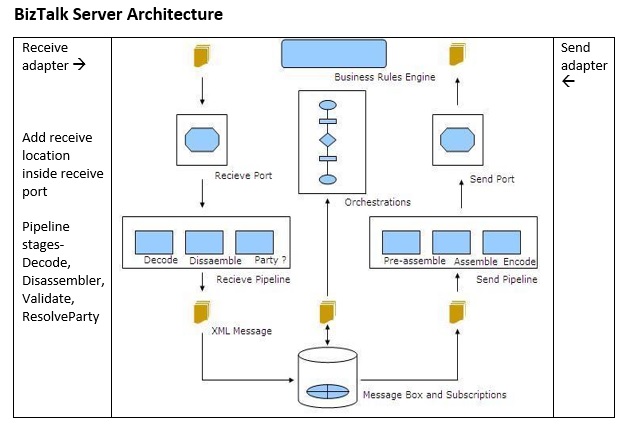
As in the above picture, Biztalk architecture is clearly showing how pub-sub architecture works but I am also going to describe it in an easy descriptive way.

Firstly once a message is available any format like in well-formatted XML or file with the assistance of any adapter protocol like SFTP, File, etc. In receive port and if message format is flat-file then we need to a receive pipeline to convert it in XML because Biztalk only communicates a message in XML.

To get in-Depth knowledge on Biztalk you can enroll for a live demo on Biztalk Online Training

biztalk server architecture

At this stage, XML message is not insert in Biztalk message box database because its need at least one subscriber but still only message is published at receiving port and when we create a send port with route a message with filter condition of its message context property or create an orchestration then create first active receive shape for receive port and then logical subscribers send port then whole XML message insert in Biztalk message box database and move message further as design orchestration business flow.

We can also create business rules separately and call it in  Biztalk orchestration as per our requirement then send either in XML messages or add send pipeline at sending port for flat messages.

So in this way Biztalk pub-sub architecture works to complete a business process.

Take your career to new heights of success with Biztalk Training

Scope and certification of MicroStrategy BI

The need to manage data better emerges with the inflow of a huge amount of data. You may consider BI to be more persons based in any corporate career. Current day corporations look forward to the platforms of Software and BI. In Business intelligence Micro strategy is the industry leader. It is a software provider for enterprise business intelligence (BI) applications. The intention of the method is as the “one-stop shop” for all reporting requirements. Therefore, it seems that the spectrum is very bright and broad.

The platform assists in the distribution of interactive dashboards, scorecards, ad-hoc queries. Besides, it also assists thresholds, alerts and automated reports. It is an ultimate data warehouse tool for reporting on data visualization. Moreover, it is with the ability to schedule reports through narrow caster acquisition. Besides, it is easy for the report building for the mobile interface. Thus, helps in dashboard reporting and its prime company.

To get in-Depth knowledge on Microstrategy you can enroll for a live demo on Microstrategy Training

Scope of Micro Strategy

Micro-strategy represents both financially and technically a big investment. It is surely up to the task for the years to come. Micro strategy BI Developers are already in high demand. Then you can expect it to increase as more and more businesses add Micro strategy to their BI Stack. Micro strategy is the ultimate forum for quick practical skill creation. Thus, you may discover the platform’s new features. Whether you are just starting out, an experienced user or Micro strategy is right in its own way. Thus, it is essential to train.

You can implement Micro strategy in almost every domain.

  • Business
  • Banks
  • Telecommunication
  • Land
  • Output
  • Training IT
  • Gas & Petrol

Micro strategy’s core functionalities are freely available to anyone. This is also a great way to push more people toward Micro strategy. The organization sees its users as the greatest asset. Thus, paying attention to its users and listening to their feedback. It really pays attention to its views and improves the products and their offers. Jump start program, Micro strategy Desktop, Stable Versions are some of the improvements. You can base it on such feedback from the customers. It expands its job opportunities through countries. The countries such as the USA, UK, South Africa, India, New Zealand, Germany, Singapore, Canada.

It is nice to be working on one of the market’s leading BI platforms. Microstrategy has a major advantage over other companies. Because they are the largest independent BI platform. Microstrategy sees itself as the best of the breed and the organizations. Thus, you can select specific innovations that lead to their particular areas.

Get More Info From Microstrategy Courses

Micro strategy Salary

The average annual “Micro strategy” salary ranges from around $70,765 per year for a Data Analyst. Besides, the salary is $131,734 per year for Senior Architect.

Microstrategy is on the right track, taking into account different needs. Then you can ensure it to be the right BI tool. You can tackle its weaknesses continuously while retaining its strong points. In terms of speed and ease of use, it is still the best mobile BI solution. Moreover, it seems to be closing the gap with its rivals. It is always good if you have certification to increase your scope in MicroStrategy.

Micro strategy Certification

Eligibility for qualification with a Micro strategy:

Microstrategy is an advanced BI tool used to develop reports. Besides, you can use it for the management of decision-making. You can use the certification for the following.

  • Specialists in Software Architects, ETL, and Applications
  • Professionals in Corporate Reporting (BRP)
  • Developers at the Entry level and

Advanced data professionals ready to build a career in Micro strategy. Moreover, it takes your career to new heights of achievement.

Preconditions:

1. Knowledge of the basic IT and operating systems.

2. Basic Micro strategy skills

3. Compatibility with remote reporting.

4. Knowledge of any other platform for data analytics and reporting will be of value.

Path for Certification with Micro strategy:

Certifications with a Micro strategy are well known throughout the industry. A certification with the Micro strategy will help you move forward in your career. It is made up of two stages.

1. Certifications at the analyst level

2. Certifications at Architect Grade

When you have completed your qualification, you will earn a digital badge. Then you can post your achievement on social media. Thus you can include your name in the accredited professionals’ Micro strategy list.

Each professional in Micro strategy should get his or her analyst-level certification. Thus, it helps in valid data scientist and developer certifications.

In stated BI positions, you may also get advance level certifications. Every architect level consumer will obtain his or her Microstrategy Certified Architect (MCA) certification. This is to verify their Micro strategy platform knowledge in all aspects. Architects and managers can obtain certifications that are more advanced. Thus, it is to exercise the Intelligence Centre’s various functions.

Certifications at Analyst Level:

The certifications at analyst level are as follows.

  • Analyst (ANL):

For this certification, you need to learn how to develop, share, and manage apps. This is by using company security, data, and application objects. Thus, helps ensure a clear version of the reality.

  • Data Scientist (SCI):

You need to know how to develop and publish advanced statistics, predictive models. Besides, you also should now about machine learning algorithms. Thus by using libraries that analysts use including TensorFlow, R, Python, and MATLAB. This to get this certification.

  • Developer(DVL):

You need to learn how to use popular programming languages for certification. This is to integrate AI technologies using common programming languages. Moreover, you can use languages like java, Python, Php, .net etc.

Certifications at Architect Level:

The certifications for Micro strategy are as follows.

Micro strategy Architect (MCA):

You need to learn how to create, share and manage the business intelligence applications to get this certification. Creating and handling schema objects and layers of abstraction on top of varying company assets. The architect of Micro strategy should be able to configure the Intelligence system on premises and cloud.

  • Analytics Architect:

You need to know how to create, publish, and optimize a federated data layer as a single version of enterprise reality to get this certification. Build and maintain schema objects and abstraction layers on top of different emerging assets in the company.

  • Application Architect (APA):

You need to know how to develop, share, and manage business intelligence applications to get this certification. Publish organized application objects and promote self-service departmental applications into the enterprise environment.

  • Mobile Architect (MBA):

You need to know how to build, compile, deploy, and manage mobile apps and environments to get this certification. Thus is for using mobile apps to improve user experience. Integrate protocols with VPN of choice, SSO, and EMM.

  • Services Architect (SVA):

You need to learn how to integrate, extend and implement analytics into third party, cloud and white-labeled portals to get this certification. Publish Web services and data services for developers to use when designing departmental applications.

  • Database Architect (DBA):

You need to know how to develop and maintain the company assets for the database to get this credential. Optimize database efficiency and usage based on the type of query, usage patterns, and application design specifications.

  • Application Administrator (PLA):

You need to learn how to access and configure the On-site and/or Cloud Intelligence Infrastructure to receive this credential. Moreover, should also manage security, track system usage and automate the architecture to reduce bugs, increase uptime and increase performance.

  • System Administrator (SYA):

To achieve this credential, you need to learn how to continuously set up, operate, monitor and sustain the network environment by running on AWS, Azure, Windows or Linux while improving performance and cost control.

  • Director of the Intelligence Center (ICD):

To achieve this credential you need to know how to create intelligence environments by integrating the Intelligence System, managing the Intelligence Center and running Intelligence Programs to support businesses and all component mobility.

Conclusion:

I hope you reach to a conclusion about Micro strategy BI by reading this article about its application and certifications. Micro strategy lets you connect enterprise applications and systems. Microstrategy is one of the demanding business intelligence tools. It is best in mobile BI applications and is showing its rivals the intense competition. You will learn more about Micro strategy and get your certification through the certification course on Micro strategy. I hope you find this article enlightening and go ahead with Microstrategy online training.

Useful Features of React.js and One can leave Angular.js

Useful Features of React.js and One can leave Angular.js

Angular and React, both are fabulous JavaScript UI frameworks that have made developing quality applications with the intended interface designs a breeze. 

While Angular.js is an app development framework that is available around for some time now, React.js is just an interface development framework, which is not that old. Although Angular.js offers excellent features, React.js with amazing rendering performance has proved to be a much sought after choice for many projects.

In this post, I will compare these two blissful frameworks and analyze the compelling factors that suggest React is a preferable choice rather than Angular for developing an incredible application interface.

Let’s explore the resourceful benefits of implementing the React framework in a project.

To get in-Depth knowledge on Angularjs you can enroll for a live demo on Angularjs Online Course

1. Lightweight DOM For Better Performance

React embraces a lightweight implementation of the events system and DOM. It doesn’t use the browser but allows one to manipulate the DOM version stored in the memory. This certainly delivers fast and effective performance. Since several developers have experienced terrifying performance issues of DOM while working with Angular, they prefer switching to the React framework

Here’s why.

The data in Angular is bound to the DOM. Thus, whenever there is any data change, a process of rendering an entire page is triggered. When a huge chunk of complex data is in there, it ultimately impacts the performance. On the contrary, while using the virtual DOM to React, complete data rendering is not needed. In this case, the complete work is done in JavaScript and only the changes are applied via the Diff algorithm (used by React.js). It, thus, doesn’t need heavy DOM and offers a prolific performance.

Take your career to new heights of success with Angularjs Online Training

2. Easy Learning Curve

The straightforward API of the React framework makes it very easy for one to get started. You can kick start development of this framework with its simplified programming approach. There is no need to make painstaking efforts in learning complicated concepts, you can create the desired interface design by using a suitable API. Yes! It is as simple as that, and thus, it makes a viable choice. Whereas, for getting started with Angular, one needs to get his hands on specific concepts and conventions. Although, it may result in magical output, incurs indefinite efforts and a hefty price to learn these essentials.

Get More Information on Angular Training

3. The desired interface can be created in a relatively easy manner.

You can proficiently design an app interface with Angular. However, React offers a more scrutinized approach to design an interface. Let’s explore a few design concepts.

  • Nested View: You can easily use the nested elements in React. It can be accomplished by including a reference to the child class within the render method of the parent class. The method is much simpler, cleaner and easier than working in the same with Angular framework.
  • Loop: Using loops in a program can help create rendering views in the Angular framework as well as the React framework. However, the techniques of using loops in both frameworks are fairly different.
  • Take your career to new heights of success with Angular Online Training

In Angular, the “ng-repeat” directive is implemented to create rendering views via loops. In React, JSX that is JavaScript is used to create a loop over numerous HTML elements and then, to stack them into an array. This offers a much simpler technique that can be deployed easily.

4. Components Support And Little Dependencies

The default JavaScript package manager (npm) has enticed several developers to implement the Node.js platform with its amazingly useful features. Unlike AngularJS that doesn’t support Node.js, you can easily use the Node.js platform in the front end while working with React. This is so because, in React, everything is treated as components. Therefore, you can easily import components by just writing the below line.

require(‘my-component’)

Moreover, the React framework also offers a module named as “commonjs” that facilitates one to install via npm with ease.

Reflection

No doubt Angular is an awesome JavaScript framework that helps maintain a development project with flair and augments agile application development. However, there are some downsides as well. 

One has to go the extra mile to use Angular, as it demands a steep learning curve, one must have expertise in dealing with a plethora of concepts like modules, filters, dependency injection, templating and a lot more to get started with Angular.js. This has encouraged developers to seek another alternative, namely React.js, that helps accomplish the UI development with greater efficiency. The above mentioned are a few captivating benefits of implementing the React framework instead of the Angular framework.

Directives for AngularJS HTML DOM

Angular is an open-source web application framework based on Type-Script. AngularJS is also an open-source JavaScript-based web framework for dynamic web applications. It allows the usage of HTML as a template language. It also allows us to extend HTML syntax to express application components. AngularJS aims to increase browser applications with MVC (Model-View-controller) capacity. And also to reduce the amount of JavaScript that needs in web applications functions. Furthermore, Angular is faster in comparison with AngularJS. Angular has many good versions and the latest is version 1.7

Today AngularJS is one of the popular modern web frameworks. It helps to create rich internet applications. It consists of different templates and models. It makes the browser much smarter without using native extensions.

DOM (Document Object Model) in AngularJS acts like an API for JavaScript. Using DOM elements it can be defined as the logical structure of the documents and their manipulations. It also defines various methods and properties for all HTML elements. While loading a webpage, the browser creates a DOM for the respective page.  

To learn more about features of AngularJS, you can enroll for a live demo on Angular Online Training

DOM is useful in AngularJS for the following reasons.

  • Using DOM, a programmer can navigate document
  •  structure.
  • All documents are built by DOM elements.
  • With the help of DOM, a programmer can add content and other elements.
  • A programmer can alter the content using DOM.
  • It helps to define the different properties of HTML

AngularJS architecture

AngularJS follows the MVC framework. It includes Model, Views, and Controller. Let us discuss it in detail.

The Controller part of this architecture represents the layer that contains business logic. Here, the user events trigger the stored functions inside the controller. User events are one of the parts of the controller. 

The views are presented to the end-user as a presentation. 

Models in this framework help to present the data. This data can be very simple or maybe complex as structured data. For example, if we are preparing a student application, then the data model consists of a student name and his ID. It could be different for other data models. 

There are different versions of Angular. But the most popular versions are Angular 2 & 4. These versions of Angular are helpful for the development of enterprise applications with better standards. Furthermore, Angular 4 is faster than version 2. Angular is much faster than AngularJS. There is a slight difference between Angular and AngularJS. Angular contains Typescript while AngularJS contains JavaScript. Moreover, it has a better algorithm for data binding and component-based architecture. These components are independent and make them reuse and test user-friendly.  

Directives in AngularJS

Most of the directives in AngularJS start with ng. Here ng means Angular. Directives in Angular are like markers on a DOM element. It informs AngularJS to transform the DOM element. It also extends the HTML element. 

The directives used to bind the application data to the attributes of HTML DOM are as follows. :-

Take your career to new heights of success with Angular Training

ng-disabled: It is used to disable the given control. Using this, the attributes of HTML elements can be disabled. The following syntax represents the directive.

<input type = "checkbox" ng-model = "enableDisableButton">Disable Button
<button ng-disabled = "enableDisableButton">Click Me!</button>

ng-show: This directive shows or hides the HTML element or the given control. The syntax for this directive is;

<input type = "checkbox" ng-model = "showHide1">Show Button
<button ng-show = "showHide1">Click Me!</button>

ng-hide: This directive of AngularJS hides the HTML element. The syntax is as follows; 

<input type = "checkbox" ng-model = "showHide2">Hide Button
<button ng-hide = "showHide2">Click Me!</button>

ng-click: It represents the click event in this directive. The syntax for the same is;

<p>Total click: {{ clickCounter }}</p>
<button ng-click = "clickCounter = clickCounter + 1">Click Me!</button>

The DOM or Document Object Model is useful for changing, manipulating and accessing the contents within the documents. It is possible only by using HTML or XML files. The directives of AngularJS represent the different activities of the DOM model.

There are some other types of AngularJS directives. Such as; Built-in Directives and Custom directives.

Built-in directives are predefined directives in a framework. We can directly use them in our applications. The built-in directives include ng-init, ng-model, ng-if, ng-repeat, ng-bind, etc. Whereas, Custom directives are created by self. We can define them by ourselves. 

Furthermore, the use of directives in AngularJS allows us the flexibility to create and customize elements in web applications. 

Get More Info Here Angular Certification

What does AngularJS component requires ?

A component is AngularJS is a kind of directive which is simple to configure and also suitable for the applications based on components. This framework makes it easy to write or create an application.

The following are the benefits of using these components. :-

  • These are easy and simpler to configure than plain directives.
  • It promotes best practices.
  • These are optimized for the component-based framework. 
  • Writing these directives becomes easier.

Components never alter or change any data or DOM. In AngularJS, generally, it allows making changes to the data. The components contain a lifecycle. Components can only control their own data and views. But cannot change other DOM or data. 

Advantages of AngularJS

There are many advantages to AngularJS. The following can be discussed;

  • It is an open-source framework. So, we can expect a small number of errors or issues.
  • It provides two-way binding features. It helps to sync data and reduces the amount of writing JavaScript. It automatically syncs the HTML data.
  • AngularJS supports both unit and integration testing.
  • It also takes care of routing. It helps to move from one view to another. It is the key functionality of single-page applications. 
  • It helps in extending HTML using directives. These features give more power to the web applications.
  • Its Markups lives in DOM.
  • Moreover, it uses plain JavaScript objects.
  • It has a simple and improved architecture.
  • It has a better declarative User Interface.
  • Furthermore, it enables to reuse codes.
  • It provides the convenience of testing.
  • It has better server performance

Features of AngularJS

There are many great features of AngularJS. These include;

  • The MVC framework is useful for dynamic modeling.
  • It contains HTML UI, which helps it in various ways.
  • It offers unit testing facilities.
  • It provides different templates and models. 
  • It uses different directives for different purposes. 
  • Furthermore, it offers developers the option to write client-side applications.
  • The applications are written using AngularJS to support different browsers.
  • Moreover, this framework helps to build large scale, easy to use web applications
  • Finally, its core features are, scope, data-binding, services, controller, filters, directives, templates, MVC, routing, etc.

Using AngularJS services, we can get data directly from the server. We can apply animations to our applications using this service. We can create and run different tests. Furthermore, we can move the application logic out of the application. Moreover, it helps to run end to end tests along with building simple applications.

Thus, the above writings explain the various Directives for AngularJS HTML DOM and its different features and advantages. The directives are useful for binding applications. There are many uses of these directives and their different types. It is a front-end JavaScript framework. Furthermore, It contains different features like MVC, Data Model binding, minimal code writings, unit testing, etc. To get deeper knowledge on AngularJS and its various directives along with its uses one can opt for Angularjs Online Training from various online sources. This learning will give a great skill along with a scope for enhancing my career successfully.

Dynamic EntryComponent in Angular

Introduction 

 Angular is an open-source Javascript framework to build web applications in HTML and Javascript. It will provide us a great deal of flexibility and power when building our apps. 

Entry component

 A bootstrap component is an entry component that Angular loads into a DOM Module at application lunch and other root components are loaded dynamically into entry components. There are two main kinds of entry components:

  • The bootstrapped root component. (Router)
  • A component you specify in a route definition. (Entry Component)

To learn more about features of AngularJS, you can enroll for a live demo on Angularjs Online Training

In the below example, the App Component is a root component so Angular loads this dynamically:

Example:

  • Create a New Project

Create a new folder named DynamicComponentsInAngular9 and select this folder in Visual Studio Code

  • Install Angular 9

Open Terminal windows in Visual Studio Code install Angular 9, as shown below: To install the CLI using npm, use the command: npm install -g @angular/cli To create a sample project with CLI, use the command: ng new DynamicComponents 

Take your career to new heights of success with Angular Training

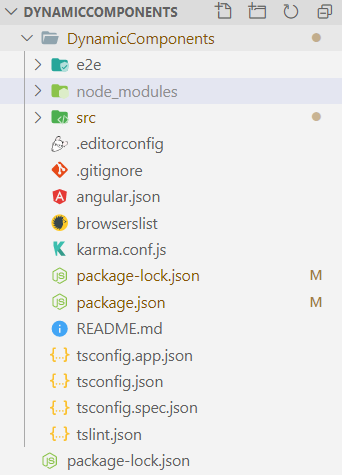
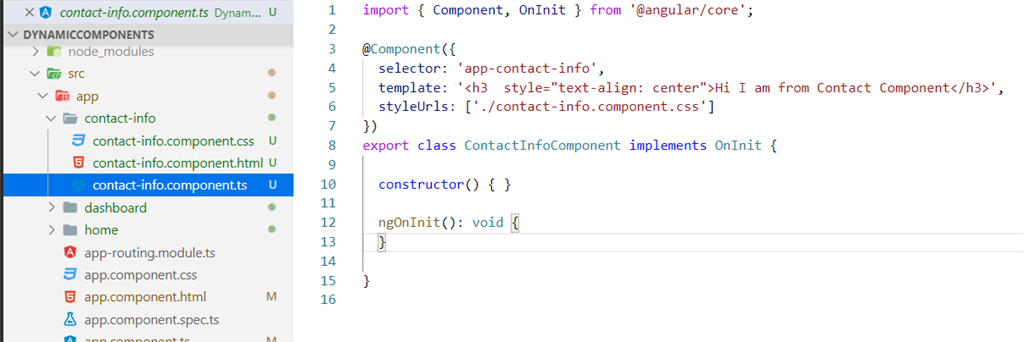
Structure of Project

  • Create Children Components

Create a new folder named components in src\app folder. In this folder, create children components as shown below: 

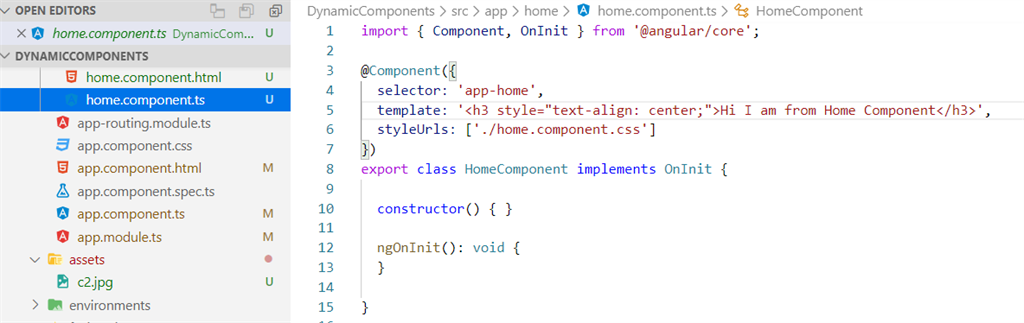
Home Component

 Create a new folder named hi in src\app\components folder. In this folder, create a new file named Home.component.ts 

ng g c Home –skipTests=true

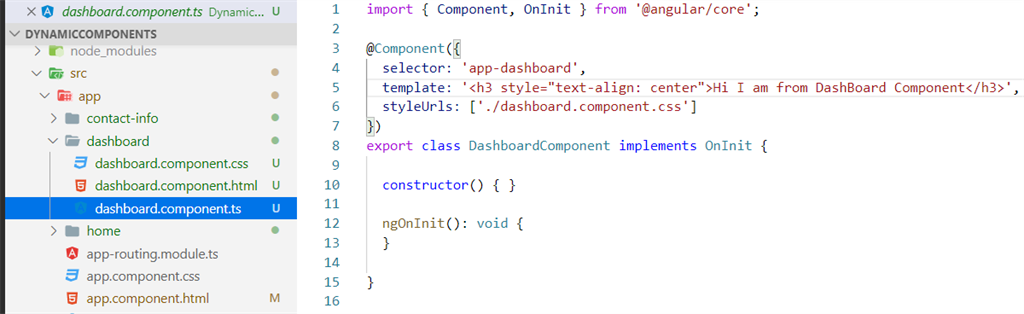
Dashboard Component

 Create a new folder named hi in src\app\components folder. In this folder, create a new file named Dashboard.component.ts

 ng g c Dashboard –skipTests=true

ContactInfo Component

 Create a new folder named hi in the src\app\components folder. In this folder, create a new file named ContactInfo.component.ts 

Get More Info Here Angular Certification

ng g c ContactInfo–skipTests=true

Open Main Component

import {  
    Component,  
    OnInit  
} from '@angular/core';  
import {  
    HomeComponent  
} from './home/home.component';  
import {  
    DashboardComponent  
} from './dashboard/dashboard.component';  
import {  
    ContactInfoComponent  
} from './contact-info/contact-info.component';  
@Component({  
    selector: 'app-root',  
    templateUrl: './app.component.html',  
    styleUrls: ['./app.component.css']  
})  
export class AppComponent implements OnInit {  
    title = 'DynamicComponents';  
    dynamicCom: any;  
    ngOnInit() {  
        this.dynamicCom = HomeComponent;  
    }  
    dynamicDash() {  
        this.dynamicCom = DashboardComponent;  
    }  
    dynamicContact() {  
        this.dynamicCom = ContactInfoComponent;  
    }  
    dynamicHome() {  
        this.dynamicCom = HomeComponent;  
    }  
}  
// Root Component html    
<div class="container ml-10 mt-2" style="width:100;">  
    <a class="navbar-brand" href="#">  
        <img src="assets/c2.jpg" width="1111" height="200">  
        </a>  
        <h2 style="text-align:center;text-decoration:dotted;background-color:gainsboro;">Dynamic Entry Components </h2>  
        <nav class="navbar navbar-expand-lg navbar-white bg-white pt-4">  
            <button class="btn btn-outline-primary col offset-1" (click)="dynamicHome()" type="submit">Home</button>  
            <button class="btn btn-outline-primary col offset-1" (click)="dynamicDash()" type="submit">Dashboard</button>  
            <button class="btn btn-outline-primary col offset-1" (click)="dynamicContact()" type="submit">ContactInfo</button>  
        </nav>  
        <div class="pt-5">  
            <ng-container *ngComponentOutlet="dynamicCom"></ng-container>  
        </div>  
    </div>    

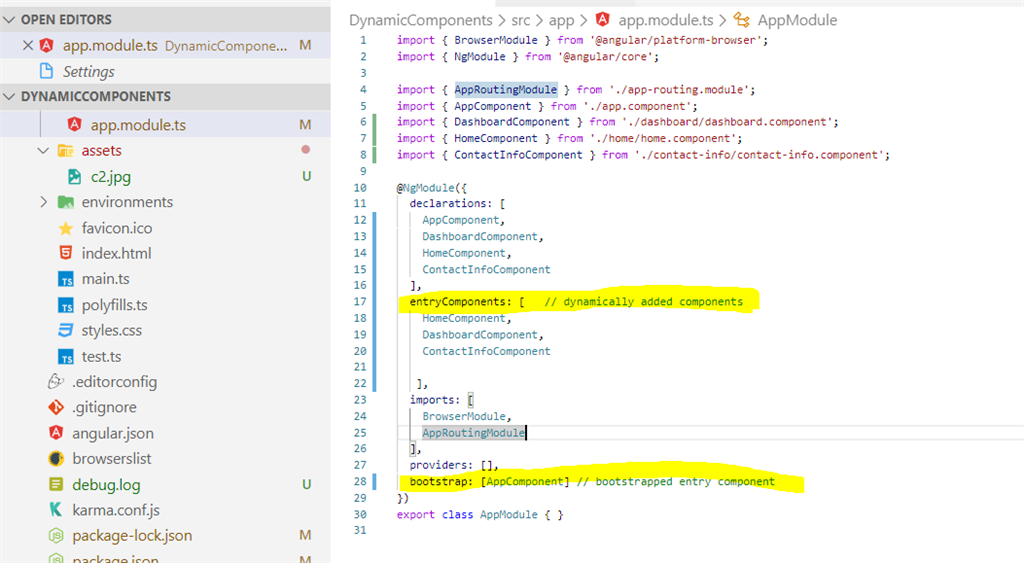
Open Component to Module and see that the Child components are added:

import {  
    BrowserModule  
} from '@angular/platform-browser';  
import {  
    NgModule  
} from '@angular/core';  
import {  
    AppRoutingModule  
} from './app-routing.module';  
import {  
    AppComponent  
} from './app.component';  
import {  
    DashboardComponent  
} from './dashboard/dashboard.component';  
import {  
    HomeComponent  
} from './home/home.component';  
import {  
    ContactInfoComponent  
} from './contact-info/contact-info.component';  
@NgModule({  
    declarations: [  
        AppComponent,  
        DashboardComponent,  
        HomeComponent,  
        ContactInfoComponent  
    ],  
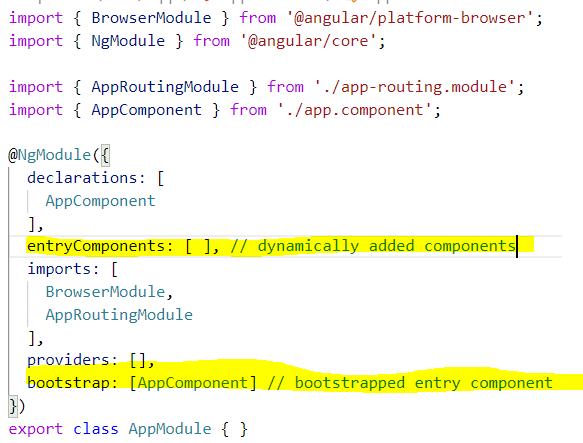
    entryComponents: [  
        HomeComponent,  
        DashboardComponent,  
        ContactInfoComponent  
    ], // dynamically added components    
    imports: [  
        BrowserModule,  
        AppRoutingModule  
    ],  
    providers: [],  
    bootstrap: [AppComponent] // bootstrapped entry component    
})  
export class AppModule {}  

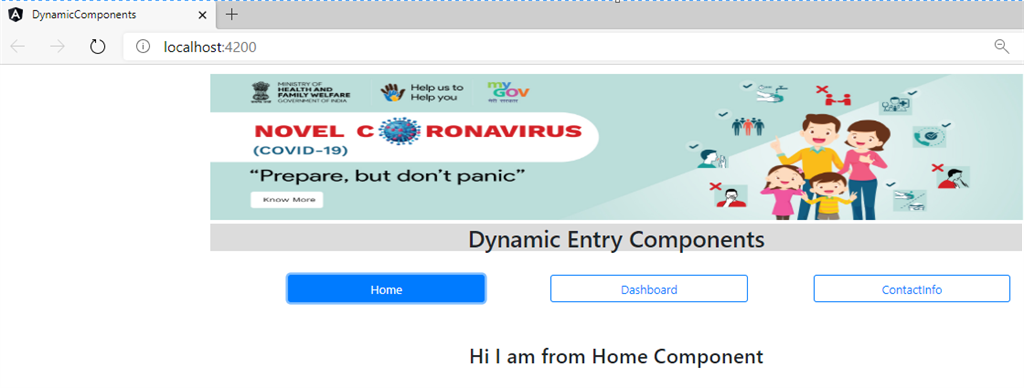
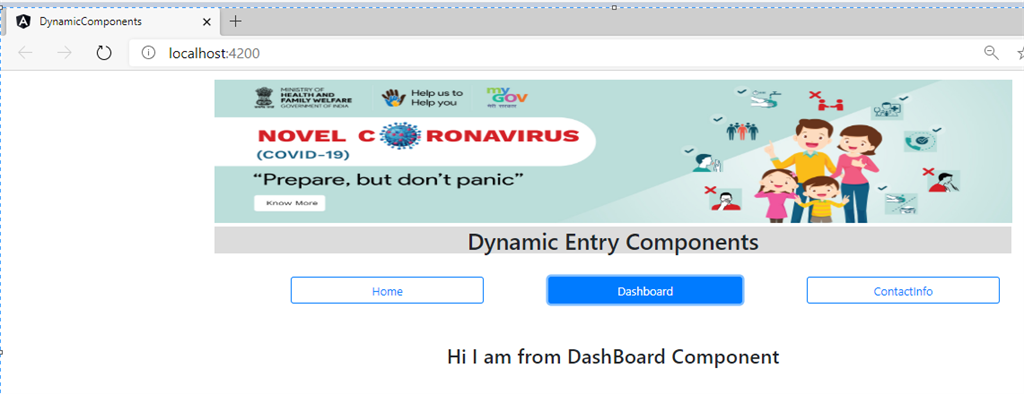
Run Application

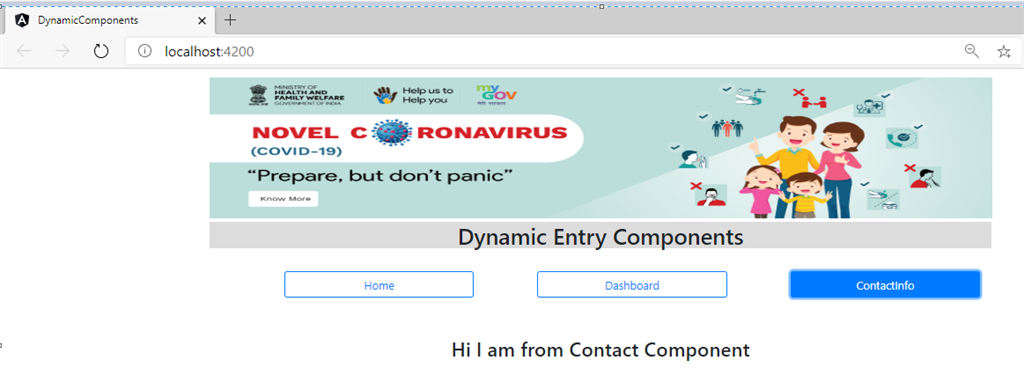
 In Terminal windows in Visual Studio Code, type: ng serve –open, program. It will open the URL http://localhost:4200/ in the browser.

Output 

Introduction to Encapsulation in Java:

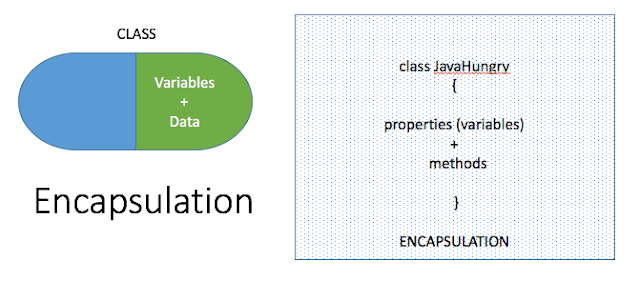
Encapsulation is one of the core concepts of java. In Java, it can be achieved by declaring all variables (data) as a private member and associating these variables with the public get and set methods.
The variables are declared private, the members of other class can’t access the data of encapsulated class directly until the get or set methods are used. Thus, data of encapsulated class are hidden from other classes. Due to this reason, Encapsulation is also called as Data Hiding.

To get in-Depth knowledge on Java you can enroll for a live demo on core Java Online Training

In this concept each member is associated with two kinds of methods:

Setter Method: This method is used to set the value of a private member of the encapsulated class. It takes a value as an argument and assigns that value to the private member. It is written as follows:

public void setMember(datatype value)
{
     this.value = value;
}

Getter Method: This method returns the value of the private member of the class. It is written as follows:

public datatype getMember()
{
    return value;
}

Real-Life Example of Encapsulation:

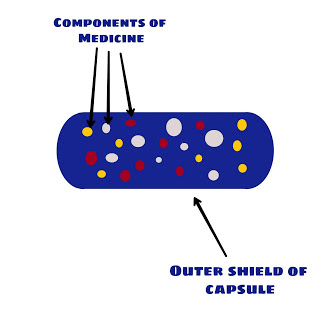
Let’s understand the concept of Encapsulation with the help of a real-life example. For example, consider a Capsule (Medicine). The powder of the capsule consists of various components as well as the outer shield of the capsule protects the internal components from the outer environment. In a similar way, with the help of Encapsulation, we can wrap data and code as a single unit and protect it from outer code.

Take your career to new heights of success with Java Training

encapsulation in java
encapsulation

General Syntax:

public class JavaHungry
{
    private datatype sampleMember1, sampleMember2;
    
    public void setMember1(datatype value)
    {
        this.sampleMember1 = value;
    }
    
    public void setMember2(datatype value)
    {
        this.sampleMember2 = value;
    }
    
    
    public datatype getMember1()
    {
        return sampleMember1;
    }
    
    public datatype getMember2()
    {
        return sampleMember2;
    }
}

The general syntax for encapsulation in Java is shown above. The members of the class are declared private whereas the methods to get and set the values of these members are declared as public. Thus, the outer classes can’t access the members directly instead they have to use these public methods.

Get More Info Java Certification Course

Example for Encapsulation:

//Bank.java (Java file containing Encapsulated Class)
class Bank
{
    private String branchName;
    private String branchCity;
    private int branchPin;
    
    public void setName(String value)
    {
        this.branchName = value;
    }
    
    public void setCity(String value)
    {
        this.branchCity = value;
    }
    
    public void setPin(int value)
    {
        this.branchPin = value;
    }
    
    public String getName()
    {
        return branchName;
    }
    
    public String getCity()
    {
        return branchCity;
    }
    
    public int getPin()
    {
        return branchPin;
    }
}

In the above java program, we have created an encapsulated class Bank containing branchName, branchCity, and branchPin as private members. The getter and setter methods are created for each of these private members.

//TestEncapsulate.java (Java File Containing main() method)

public class TestEncapsulate
{
    public static void main(String args[])
    {
        String name, city;
        int pin;
        Bank bank = new Bank();
        bank.setName("Sample Bank");
        bank.setCity("Sample City");
        bank.setPin(100000);
        name = bank.getName();
        city = bank.getCity();
        pin = bank.getPin();
        System.out.println("Branch Name: "+name+"\n City: "+city+"\n Pin: "+pin);
    }
}

Output:
Branch Name: Sample Bank
 City: Sample City
 Pin: 100000
 

Advantages of Encapsulation:

1. Data Hiding: Encapsulation provides a protective shield to the members of a class and prevents it from the outer code. The user will not know how and where the data is being stored. Users will be unaware of the inner implementation of the class. Therefore Encapsulation provides the facility of Data Hiding from outer classes and users.

2. Flexibility: Encapsulation creates the code more flexible. There is no need to worry about how and where to store data as well as how to access them because getter and setter methods do these functionalities.

3. Reusability: The code becomes more useable as it’s easy to change the encapsulated class with the change of requirements.

Design a site like this with WordPress.com
Get started